

Aggressive oral cancer can be identified at an early stage by changes in lymphatic vessels
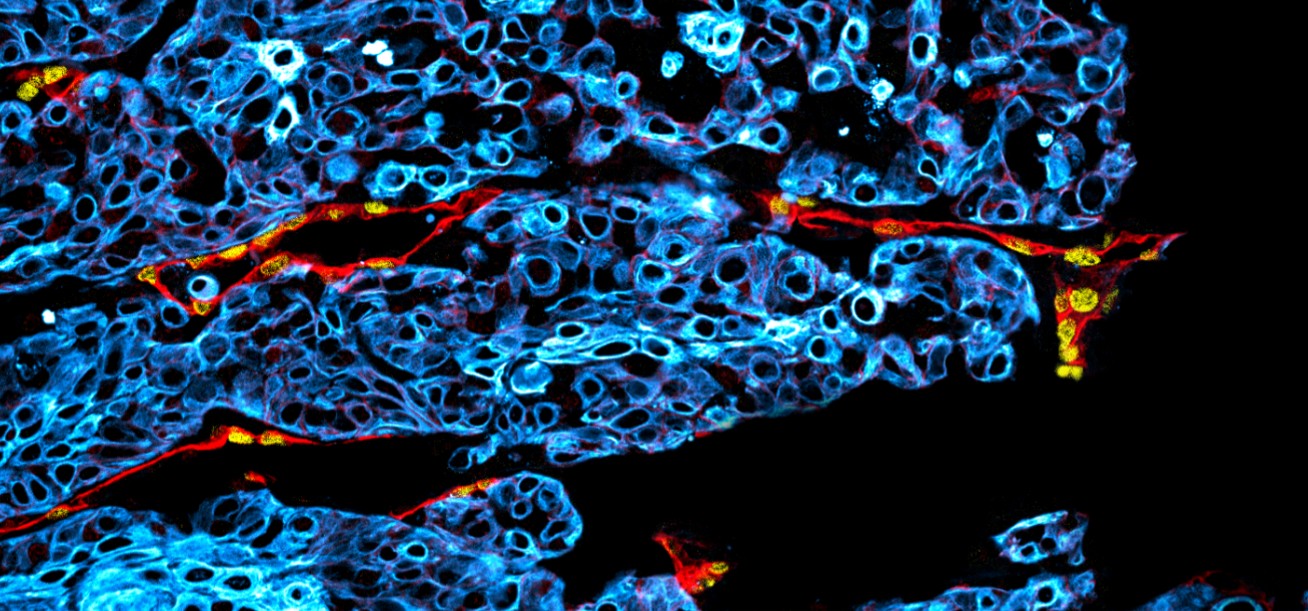
Microscopic image of a human oral cancer tumour with lymphatic vessels (red and yellow) running between the cancer cells (blue). The width of the tumor in the picture from left to right is about 0.5 mm.
It is crucial to identify aggressive forms of the disease at the diagnostic stage to ensure that the increased risk of cancer recurrence and death can be addressed when planning the treatment.”
TURKU, FINLAND, February 18, 2026 /EINPresswire.com/ -- Oral cancers with a high risk of recurrence can be identified at an early stage by examining the lymphatic vessels of the tumour. Finnish researchers have discovered for the first time that the surface cells of the lymphatic vessels in oral cancer contain proteins that indicate cell division and strongly predict disease progression and mortality.— Doctoral Researcher Joni Näsiaho
Oral cancers are the most common malignant tumors in the head and neck region, causing more than 188,000 deaths worldwide each year. Unlike in many other cancers, even small and early-stage tumors in oral cancer can lead to death. In Finland, where the study was conducted, up to a fifth of patients treated in the early stages later die from the disease.
The research team from the University of Turku and the InFLAMES research flagship used early-stage oral cancer samples collected from approximately 300 Finnish patients to study the properties of various defence and structural cells found in the tumor tissue. By studying multiple different protein markers, the researchers made the surprising discovery that some tumors showed a higher number of proliferating lymphatic vessels than normal. The high number of proliferating lymphatic vessels predicted cancer recurrence and death better than any other previously known risk factor for oral cancer.
Lymphatic vessels are normally present in the mouth, but in a healthy oral cavity, their cells rarely divide and marker proteins indicating this process are not usually seen.
"It is crucial to identify aggressive forms of the disease at the diagnostic stage to ensure that the increased risk of cancer recurrence and death can be addressed when planning the treatment. Currently, local oral cancer treatment mainly involves surgery, and there are no precise methods for targeting adjuvant therapies. We need biomarkers so that we can treat high-risk patients more effectively and avoid exposing patients with a better prognosis to the potentially serious adverse effects of adjuvant therapies,” says the lead author of the study Joni Näsiaho, a Doctoral Researcher at the University of Turku and a physician specializing in oncology.
“We are excited about the results and believe that the findings could also be applied as a practical tool for clinical use. Furthermore, it would be interesting to find out whether the marker we discovered has a similar predictive value in other cancer groups,” says Näsiaho.
The study was published in the prestigious medical journal Cell Reports Medicine. The work was funded by the Research Council of Finland, the Cancer Foundation Finland, and the Finnish Government research funding, and was carried out at the MediCity Research Laboratory of the University of Turku in the group of Professor, InFLAMES group leader Marko Salmi. In addition, three ear, nose and throat specialists who treat and study oral cancer in the Turku University Hospital also participated in the study.
Joni Näsiaho,
University of Turku
communications@utu.fi
Legal Disclaimer:
EIN Presswire provides this news content "as is" without warranty of any kind. We do not accept any responsibility or liability for the accuracy, content, images, videos, licenses, completeness, legality, or reliability of the information contained in this article. If you have any complaints or copyright issues related to this article, kindly contact the author above.
